Plurality Tokyo Namerakaigi #2
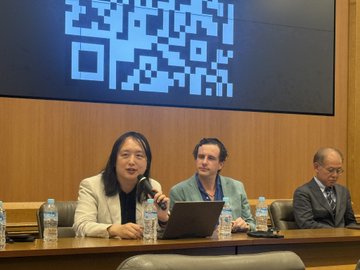
Audrey Tan, former Digital Minister of Taiwan, and Glenn Weil, economist known as the author of "Radical Markets," co-authored "Plurality: The Future of Collaborative Technology and Democracy" in Japanese PLURALITY: The Future of Collaborative Technology and Democracy, Turning Conflict into Creation" will be held to celebrate the release of the book. --- [Event to celebrate the launch of the Japanese edition of "PLURALITY" co-authored by Audrey Tan and Glenn Weil (2025.5.10) | NEWS | Keio University X Dignity Center https://www.x-dignity.kgri.keio.ac.jp/news/848 /]
- Date: Saturday, May 10, 2025, 1:00 p.m. - 6:15 p.m. (Doors open at 12:30 p.m.)
- Venue: 8F Hall, East Building, Mita Campus, Keio University
Event Page:.
https://youtube.com/live/s_e3kMzjF8M?feature=share
[/plurality-japanese/Plurality Tokyo Namerakaigi #2](https://scrapbox.io/plurality-japanese/Plurality Tokyo Namerakaigi #2)
ver.2
- I feel like the English part of this is through and through.
Program
- Until about 13:15: Opening
- 13:15-14:45: Session 1: Intersection of Plurality and Academic Knowledge
- 15:05-15:45: Session 2 New forms of consensus using collective knowledge.
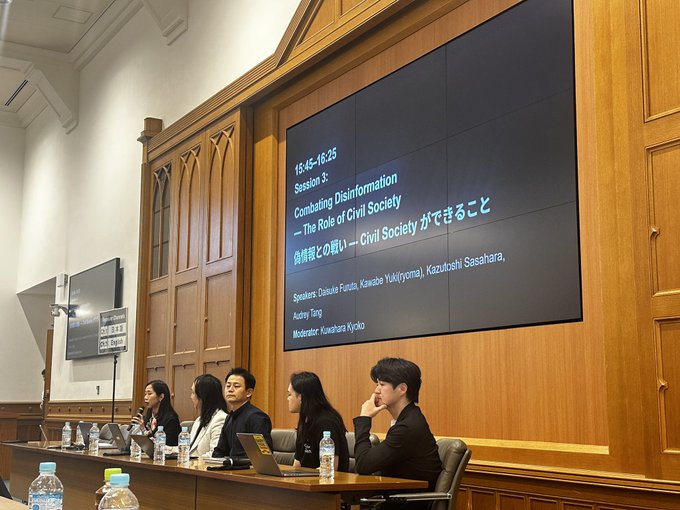
- 15:45 - 16:40: Session 3: Fighting Disinformation What Civil Society Can Do
- 16:40-17:20: Session 4: Democratic allocation of funds QF/QV discussion and practice
- 17:20-18:00: Session 5: Will AI Evolve Democracy?
- 18:00-18:15 approx: Closing
opening Mr. Ken Suzuki, Chairman of the Board of SmartNews Company and Specially Appointed Researcher at the University of Tokyo, and Mr. Shunsuke Takagi, Researcher at SmartNews Media Research Institute, Founder of Plurality Tokyo, gave opening remarks. They expressed their gratitude for hosting the conference and emphasized their goal to make the word "plurality" known to as many people as possible in Japan, and to put it into practice.
Session 1: Intersection of Plurality and Academic Knowledge The speakers in this session included Shigenori Uno (Professor, Institute of Social Science, University of Tokyo; researcher in political thought), Keigo Komamura (Professor, Faculty of Law, Keio University; constitutional law scholar), Yosuke Yasuda (Professor, Osaka University; economist), and Glenn Weyl and Audrey Tang, authors of the book "Plurality". An approach to plurality was attempted from a very academic context. • Shigenori Uno: Noting that as a scholar of political thought and philosophy, he has long been interested in and studied Tokuvil, John Dewey, and Hannah Arendt, he expressed his surprise and delight that the plurarities dealt with all three thinkers and gave them important roles. Uno argued that democracy is never about achieving one popular will, but should be a society that allows for diverse experimentation. He mentioned fandom as a form of association in our time, and said that fandom, which is often exclusive, should be created with openness. He also defined politics as the art of plurality and the art of cooperation among mutually different and equal people, and called for its restoration. Finally, he asked Audrey Tang and Glenn Weyl why they chose these three individuals.
Keigo Komamura: As a constitutional scholar, referring to his work "Doubting the Sovereign," he stated that constitutional law has a fundamental role in doubting and overriding democracy. He pointed out that the current political system is "wacky" and that there are obvious conflicts of interest in representative government. He expressed hope that simple democracy tends to become unconstrained populism and that Deliberative Democracy (Deliberative Democracy) and Democratic Experimentalism (Democratic Experimentalism) will become the driving force. In Japan today, lawsuits, rather than politics, have become an effective platform for social change. The presentation posed the following questions. • Yosuke Yasuda: As an economist, Mr. Yasuda mentioned his experience of receiving his Ph.D. from Princeton University at the same time as Glenn Weyl. He himself specializes in game theory, mechanism design, and social choice theory, and mentioned that he translated Glenn Weyl's book** "Radical Markets" and provided commentary. He stated that he came across Radical Markets while feeling troubled by the current capitalist system but feeling that existing alternatives were insufficient. Noting that economics has not adequately addressed market failures and economic disparities, he mentioned the keyword "Alone" proposed by Glenn Weyl and said that he recognized the challenge of economics' overemphasis on personal rationality and decision-making. He introduced the idea of economics contributing to plurality through a mechanism (e.g., the TTC algorithm) and a collective decision-making mechanism that does not rely on the number of votes (boat count). In particular, he praised the Majority Judgment mechanism for its superiority in revealing the distribution of ratings for each candidate and its potential to make collective decision-making visible.
Throughout the session, the potential of the concept of plurality to provide new perspectives and solutions to the challenges facing existing disciplines (political thought, constitutional law, economics) was discussed.
Session 2: New Forms of Consensus Using Collective Intelligence The speakers in this session were Mr. Tonfi, an attorney and president of Mielka, a non-profit organization, and Mr. Yasukazu Nishio, who is deeply involved in activities to promote plurarities.
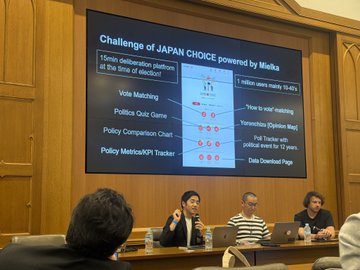
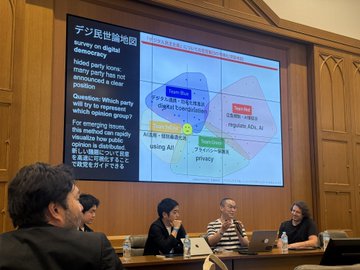
Mr. Tonfi: He introduced JPAN Choice, a service he developed and operates. He emphasized the importance of design in particular, and stated that the service aims for inclusive participation, including those with limited access to information. He explained that JPAN Choice aims to improve these three issues in democracy: information input (disinformation problem), information digestion process (moving away from intuitive and reflexive decision making by the system1), and reflection of collective will (forms other than elections and representation). Choice offers a variety of features, including boat-matching**, gamification with quizzes, policy comparisons (80+ topics), tracking of key KPIs, and guides on how to vote, and reported that over 1 million people, primarily teens to early 40s, are using it. He introduced the "poll map" he and Nishio developed for last year's election using open source software called Polis, explaining how this can visualize not just simple approval or disapproval, but also diverse clusters of opinion, divisions**, commonalities, and more.
Mr. Yasukazu Nishio: In order to spread the concept of plurality in Japan, he said he has been working on creating automatic translation lines for books and promoting broad listening tools such as Polis and Talk to the City. Together with Mr. Tonfi, he participated in the development of the public opinion map. During the discussion, he argued that a clear distinction needs to be made between collective decision-making (deciding something by voting) and gathering everyone's opinions to better understand the world (gathering information for decision-makers). Polis and the Public Opinion Map are the latter, he explained, and are "glasses" or observation systems that allow humans to better understand the world and the opinions of others, not for AI to automatically make decisions. Through the introduction of specific tools such as Polis and the Public Opinion Map, this session demonstrated how technology can help visualize diverse opinions and deepen people's understanding, thereby supporting higher quality collective knowledge formation and decision-making. Session 3: Fighting Disinformation, What Civil Society Can Do In this session, the Japan Fact Check Center took the stage to discuss how to tackle the issue of disinformation, and in particular what the Civil Society can do to help.
The strengthening of international cooperation was emphasized. He reported that even under difficult circumstances such as the Trump Factor, cooperation among fact-checking organizations has rather been strengthened, and that there are about 180 certified fact-checking organizations worldwide called IFCN (International Fact-Checking Network), which are actively exchanging information. He stated that there is a movement to establish a regional association in the Asian region as well. • He noted that cooperation with Taiwan is particularly strong, with the Japan Fact-Check Center exchanging information and conducting joint fact-checking with the Taiwan Fact-Check Center on a daily basis. He mentioned that fact-checking education for young people in Japan, Taiwan, Thailand, and Indonesia is also being conducted jointly. He noted that a joint seminar with Taiwanese Daset researchers is also planned, and expressed hope that the seminar will be held at a great venue like the Keio University X-Design Center. He mentioned that Taiwanese Minister Lo-Ping Cheng also emphasized the importance of international cooperation. • He strongly argued that Japan has the experience of enjoying a stable democracy for a long period of time in Asia and, as its responsibility, should become the Asian hub in the fight against disinformation. The session underscored the message that international collaboration, especially within the Asian region, is essential for the Civil Society to combat disinformation, and that Japan should play a central role in this effort.
Session 4: Democratic Funding Allocation QF/QV Discussion and Practice The timetable listed the session names, but there was little transcription of the specific discussions related to this session in the sources provided. Throughout the conference, there were comments that all sessions were closely related and there was a sense that the content of the book was being recovered in various places, a general reference to the challenge for civic organizations to secure stable funding, and a reference to the Retrospective Funding concept that funding should be provided later for successful ones. There were some references to the concept of Retrospective Funding, whereby successful projects should be funded later, but the details of the session itself could not be confirmed by the source.
Session 5: Will AI Evolve Democracy? This session discussed how AI can contribute to the democratic process. The name of the session was listed on the timetable. In the discussion, it was introduced that research and experiments are being conducted on "well-informed" discussions using AI agents and externalization of inner dialogues (conversations that take place in the head) by LLM agents that play diverse selves. and how to maintain alignment in reward design, and the importance of openness as a solution to this problem. He also mentioned that experiments have suggested that LLMs may increase emotional expression and recognition of inner voice in self-reflection, such as journaling. The possibility of alternating writing experiments, in which a human begins writing and the LLM continues, or a human writes where the LLM stopped writing, was also mentioned. The role of the moderator was also discussed, and the viewpoint that actively presenting opinions, in addition to asking good questions, may help stimulate discussion and facilitate communication. Furthermore, it was emphasized that the design of voice (voice) as well as text could have a significant impact on the willingness to participate in discussions and the quality of communication. He mentioned the influence of character voices such as Zundamon on discussions and the importance of optimizing voices suitable for voice interaction. The Principal AI initiative was introduced as an approach that continues the good points of Talk to the City, but increases its practicality in actual policy-making and public comment aggregation. In this session (and related chats), the potential for AI to evolve democracy as a tool for human understanding, a system to pick up and visualize diverse voices and opinions, and an agent to energize the debate process was discussed from multiple perspectives. In particular, the role of AI in supporting human judgment and understanding, rather than automatic decision-making by AI, and the importance of elements such as design and voice for this purpose were suggested. closing Ken Suzuki and Shunsuke Takagi expressed their appreciation for the success of the conference, its participants, and all those involved. The organizers, a total of 33 volunteer staff, the venue (Keio University X-Design Center, the important room where the Board of Trustees meeting to choose the President of Keio University is held), SmartNews collaborators (Se-san, Yusuke-san, Hirahara-san, etc.), the Tokyo community, interpreters, distribution companies, the person who served as the general moderator on short notice, etc, He expressed his gratitude for the many collaborations that made the event possible. He expressed his determination not to let Plurality end with this event, but to further root it in Japan and connect it to practice. He emphasized the importance of purchasing books and spreading the content (archived Japanese and English versions) through social networking sites to achieve this goal. He also introduced Tokyo Plurality Week, a series of events scheduled for tomorrow and beyond, even after the conference. Specifically, he mentioned a publishing event at the Reading Monkey Bookstore the following day (hosted by Scipose, fully booked but to be live-streamed), and a closed conference at the University of Tokyo on May 12 (with invitation slots available). Regarding the future promotion structure of Plurality, there was mention of issues such as taking over from Anno (Audrey Tang?) and who will take over the leadership, and the hope that someone from the community will be found who can provide leadership. Overall, the conference was a great success, and was shown to be an important step forward in promoting the concept of plurality and collaboration among diverse people in Japan. Due to the nature of the source, not all session discussions are recorded in detail, especially sessions 4 and 5, which contain a lot of fragmentary information and related banter.
ver.1
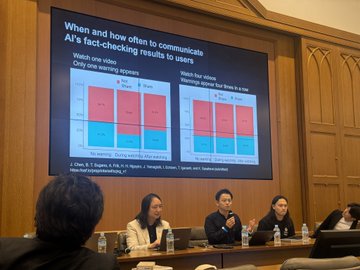
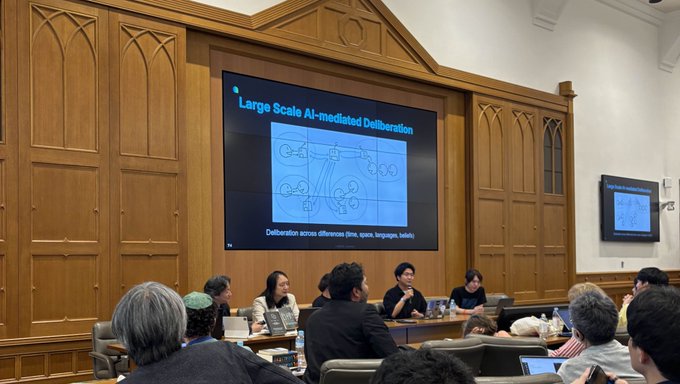
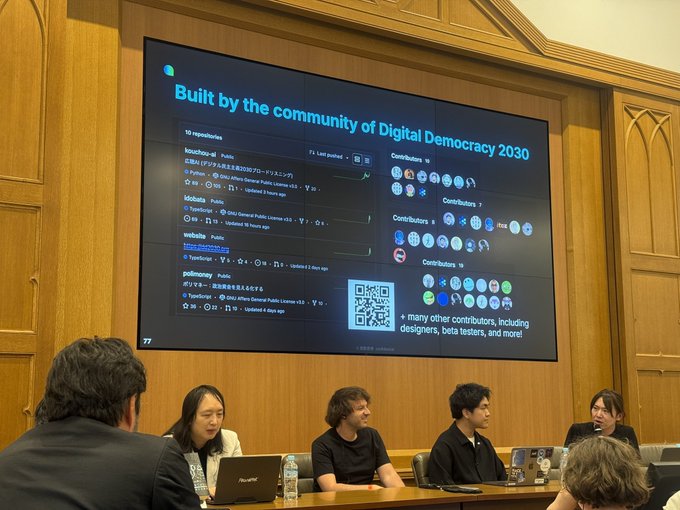
Middle to end of symposium session • The session introduced a visualization tool called Map of Public Opinion. It is based on a tool called Polis, which visualizes diverse opinions on a topic such as sales tax cuts as clusters and helps to understand divisions and points of agreement, it was explained. • The cultural tendency in Japan to avoid explicitly expressing strong opinions and how this might affect mechanisms such as quadratic baiting were discussed. • Research was shared that quadratic funding has limitations when dealing with large numbers of items (100 is possible, but 1000 or 100,000 is difficult). • During the Q&A session, in response to the question "Do individual opinions need to be based on correct understanding?", it was emphasized that collective decision-making itself should be separated from data collection to gather diverse opinions and better understand the world and the perspectives of others. polis and maps of public opinion serve the latter Polis and maps of public opinion serve the latter purpose, i.e., as "glasses "** to help decision makers make better decisions. • The importance of data access from platform companies was discussed. It was argued that data is essential for civic action and research to experiment and analyze in the digital space, and that it is necessary for platforms to provide data access to researchers and civil society through legislation such as the EU's Digital Marketplace Act (DMA).X (formerly Twitter) has made its API The fact that they are charging a fee and making it more expensive was raised as an issue. • The current situation and countermeasures against the generation of false information by AI were discussed, and the fact that AI can now generate realistic false information (fake news, images, and audio), making it difficult to determine the authenticity of information sources, was cited as a challenge. The results of an experiment showed that warnings displayed during video viewing effectively reduced the intent to share fake information. • As a countermeasure against disinformation, it was suggested that mechanisms (KYC, signature plans, etc.) be introduced to prove that the statements were made by a human being while maintaining anonymity. • It was recognized that Japan's countermeasures against disinformation are lagging behind the rest of the world (about 8 years behind), but it was introduced that international cooperation such as the International Fact-Checking Network (IFCN) and Taiwan is being strengthened. The opinion was also expressed that Japan should become a hub for countermeasures against disinformation in Asia. • After a break, the session continued. • The application of quadratic funding to participatory budgeting, a system for visualizing community contributions (assigning roles), and funding digital disaster response teams were introduced. • He emphasized the idea that democratic systems are not fixed, but should be constantly experimented with and continuously improved as technology advances. He stated that social systems, like software development, need to have an ongoing cycle of product development, implementation, testing, and improvement. • The Digital Democracy 2030 project was introduced. He talked about how this is an open source project, that participants are being recruited via Slack, and that they are developing a virtual deliberation system (a system that allows 120 million people to deliberate through dialogue with an AI) and an information disclosure system aimed at real-time disclosure of political fund balance reports. Reception/conversation after the symposium • Participants exchanged their thoughts and additional discussion about each session and specific speakers at the symposium. • Regarding the Principal AI, he explained that it is an improved version of Polis, with enhanced opinion drilling and cluster extraction for policy makers. • The audience was reminded that the high cost of the X API is a major issue in the implementation of broad listening. X API is a major challenge in the implementation of broad listening. • He spoke about the current state of the pluraritaly community in Japan. There were specific references to the sharing of information in the scrap box and the involvement of various parties (e.g., Mr. Hamada, Ms. Kay, Mr. Nou, Mr. Ito, Mr. Nishio, etc.). • Difficult issues regarding the nature of community leadership were shared. They spoke of the limitations of allowing certain people to continue to take the initiative and the challenge of how to discover and transition to natural leadership. • He mentioned the difficulty of fundraising for community activities and NPO operations. • With regard to the future of AI and democracy, he talked about research being conducted on the simulation of dialogue between individuals' inner selves (diverse selves) using AI agents and the possibility of AI agents that would want to dialogue. • The possibility that AI politicians/AI agents could more easily make decisions and be more accountable based on model specifications than human politicians was discussed. However, it was noted that designing incentives and ensuring openness were important; it was suggested that the role of politicians may change as AI begins to assist in deep research. • Ideas for experimental voting systems that differ from the current "one person, one vote" system, such as voting proportional to income tax, age, and assets, were discussed. • There were also more abstract and philosophical discussions about the future of technological evolution and the role of humans: the possibility of AI and robots surpassing many human activities, the accompanying questioning of human labor and value, the potential of AI robots as companion animals, and various perspectives on the speed of technological development, safety, and anti-technology (e.g., suicide attacks on AI) competition. The discussion covered a variety of perspectives, including the speed of technological development, safety, and the competition of anti-technology (e.g., self-destruct attacks against AI). • Surprises about the rate of development of the latest AI technologies, including OpenAI, and concerns about their impact were expressed. • Information was provided on how to participate in the Slack workspace for the Digital Democracy 2030 project. • Expectations were expressed regarding future possibilities (e.g., input/output in markdown format) for linking scrapboxes and LLMs (large-scale language models). • Conversations and personal stories about the move after the reception were included. Throughout the symposium and subsequent conversations, themes such as democracy as a plurality experiment reappeared.
https://x.com/chekichekimusu1/status/1920301061098688900
plurality_book here today #TokyoPluralityWeek
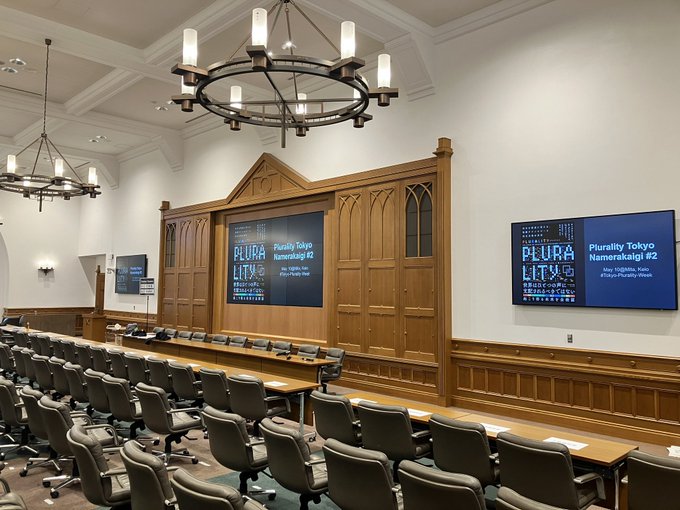
0xtkgshn voilà ! Let's go!
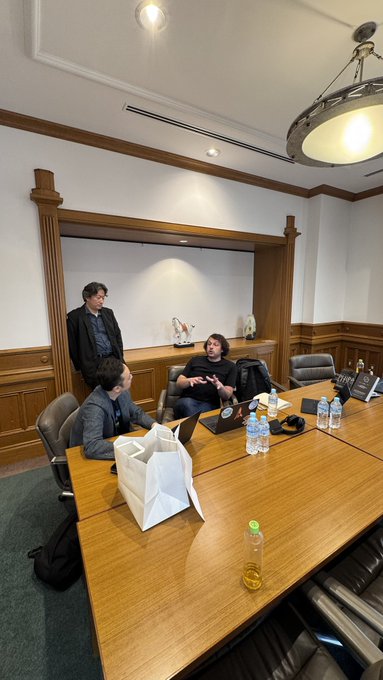

takerunakao plurality tokyo Namera Conference #2 has started ‼︎
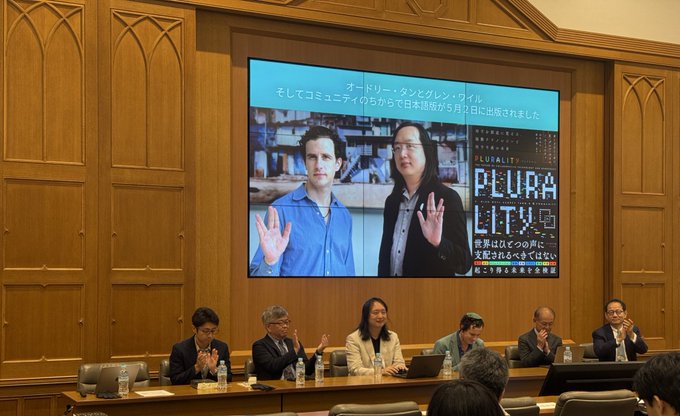
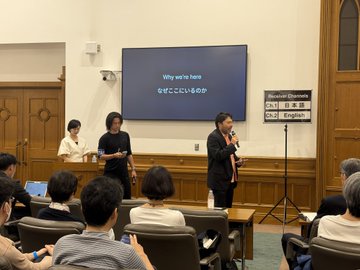
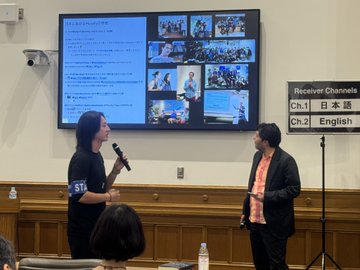
nishio Beginning! #TokyoPluralityWeek
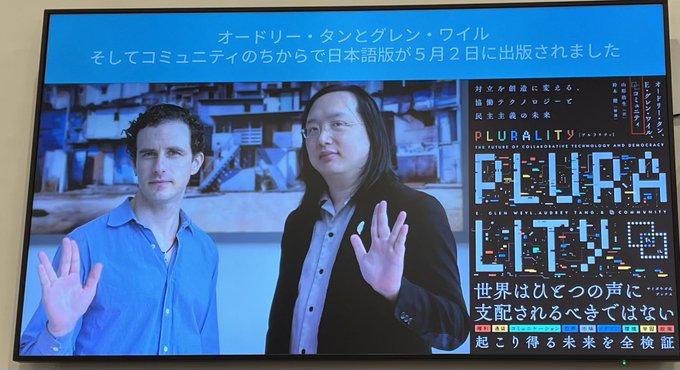
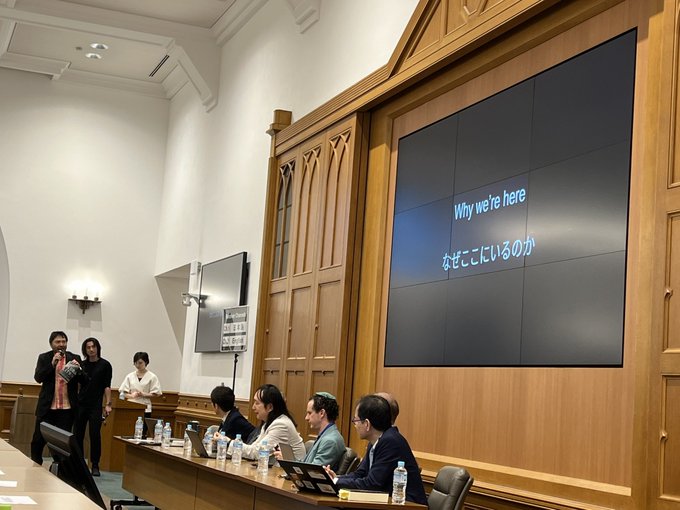
[/plurality-japanese/History of Plurality in Japan](https://scrapbox.io/plurality-japanese/History of Plurality in Japan).
nishio Talking about how we should all create events as public goods instead of consuming events created by staff as guests #TokyoPluralityWeek
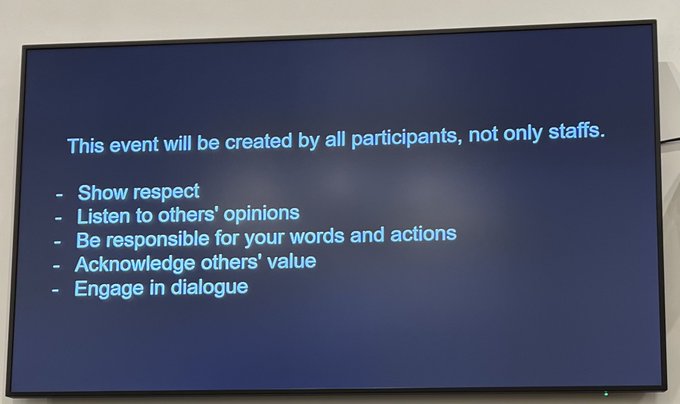
mtane0412 Seat Secured! #PluralityTokyo Secure your seat! #PluralityTokyo
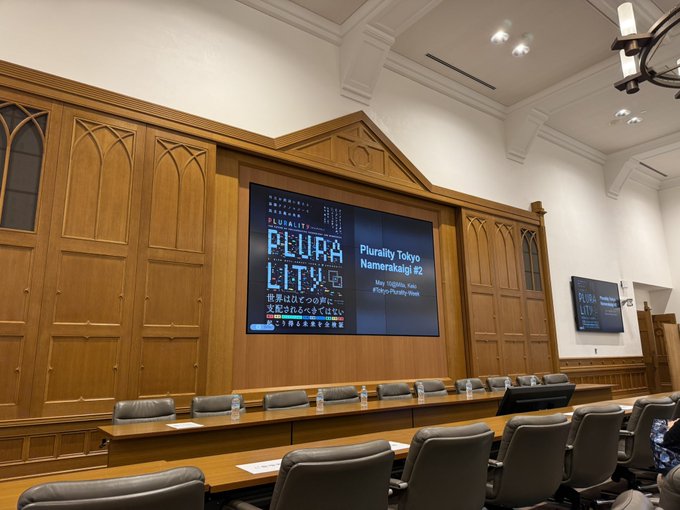
takahiroanno plurality tokyo Namera Conference #2 is here!
Yasuno's session will be the fifth one, starting at 17:00. It will be online as well!
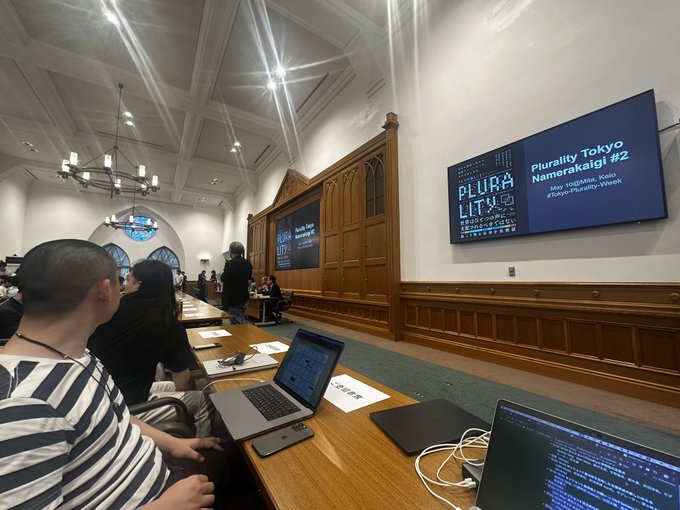
hal_sk Plurality Tokyo came! I sat in a seat at a bad angle.
0xtkgshn It's right in front of you!
hal_sk @k_0214 is currently speaking on a panel at Disinfo
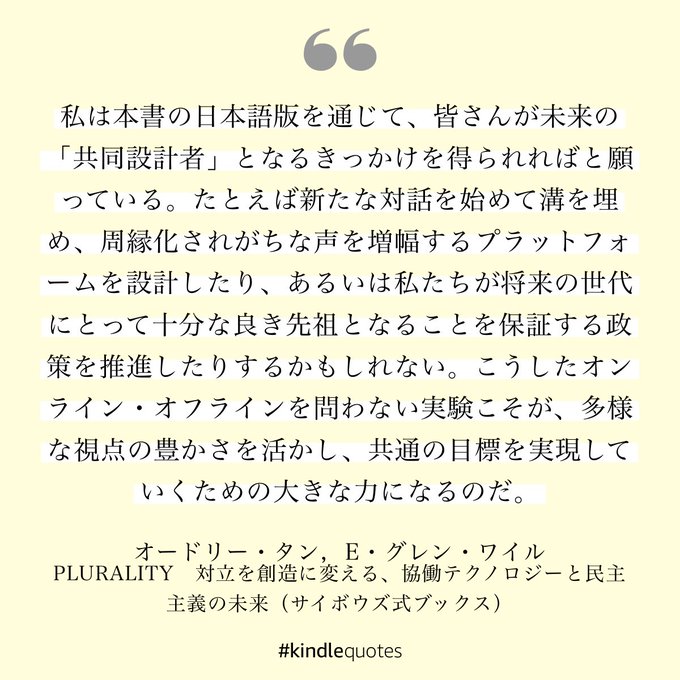
plurality_book "PLURALITY Turning Conflict into Creation, Collaborative Technology and the Future of Democracy" is CC0 Public Domain Open Source It is Quotations of texts in books are also welcome! I hope many of you will become collaborators and future co-designers of this project! #plurality
nishio #TokyoPluralityWeek
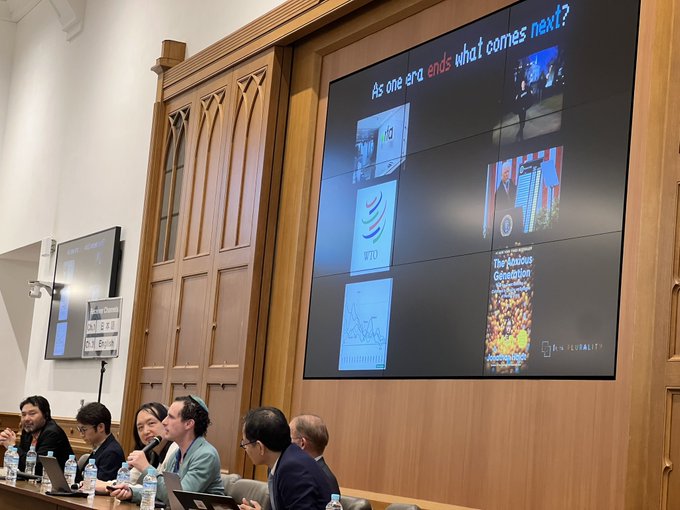
nishio #TokyoPluralityWeek 21st Century Ideology
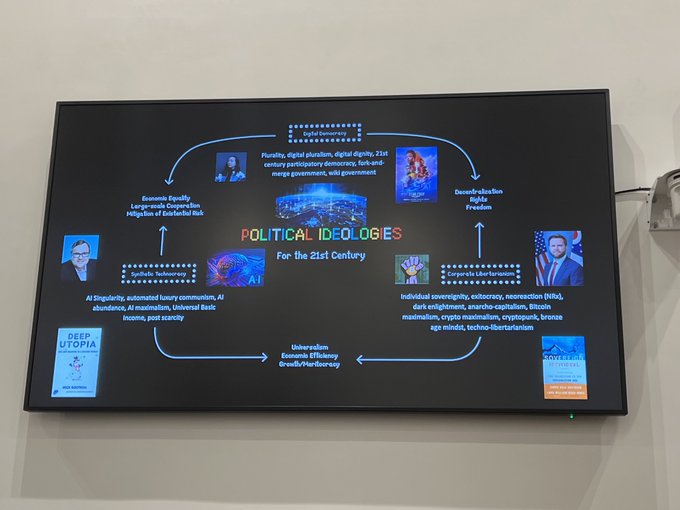
mariroom Huge congratulations to @0xtkgshn , co-hosting wonderful conference with plurality community
#TokyoPluralityWeek #PluralityCommunity Congrats to @0xtkgshn for co-hosting a great conference with multiple communities!
#TokyoPluralityWeek #PluralityCommunity
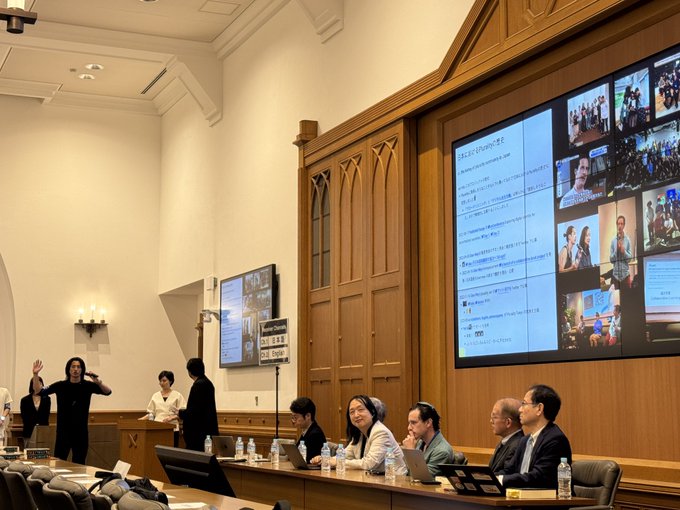
_geeknees Plurality Book is one public good
https://github.com/pluralitybook/plurality
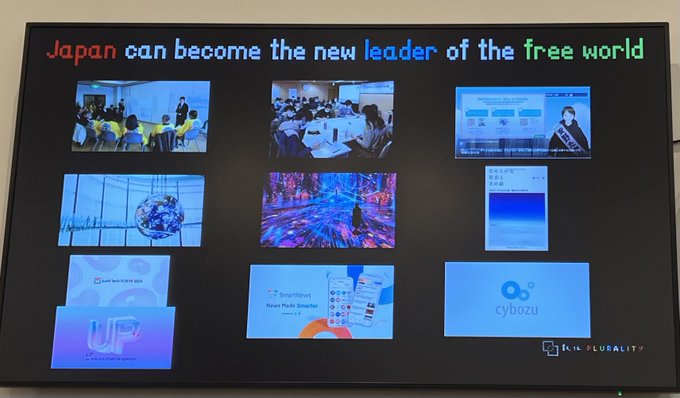
nishio "Japan can be the new leader of the free world" by Glenn #TokyoPluralityWeek
nishio Tocqueville, Dewey, democracy of experiments, the book I'm writing now is Hannah Arendt, democracy is to allow diverse experiments (Dewey). Fandom is a modern association The art of plurality, politics as something diverse people can work together on #TokyoPluralityWeek
nishio Tocqueville, Dewey and Hannah Arendt as Thinkers Connecting Asia
nishio "Representation is a clear conflict of interest" "The Constitution overrides democracy" "Being a politician is a punishment" I'm sitting next to Mr. Anno w # TokyoPluralityWeek
higu_yuu You got it so good! Shinwa_Defense It's interesting that Mr. Komamura says what he wants to bust out first, w nishio The story is too funny w the audience is filled with laughter.
nishio I didn't know that the way to change society is not only through elections but also through civic tech/crowdsourcing lawsuits, interesting #TokyoPluralityWeek
Parascorpaena CALL4 https://call4.jp

Parascorpaena I'll try to put something in writing too!
cactaceae Democracy without some adjective is just unlimited populism #TokyoPluralityWeek
nishio "Suzuki Ken and Suzuki Kan" lol
It's amazing that you're doing electronic meeting rooms in 1996. #TokyoPluralityWeek
nishio "Recommendations for Deliberative Discussion" "Policy Contest": Public Comment from the Younger Generation Leads to Major Reform of Budget Allocation "Public" will be compulsory from 2020
nishio Audrey: "A major advance in technology in the last two years is that LLM has made it easier to aggregate opinions. This improves deliberation. In particular, we are now able to communicate with more diversity across language barriers" #TokyoPluralityWeek
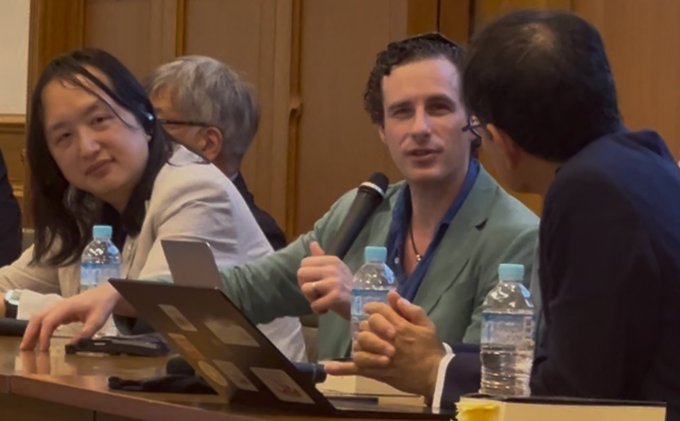
nishio ALONE to Plurality Market without money -> barter -> double coincidence of desires -> TTC algorithm -> why hasn't it spread, because it only takes one break in the N-person cycle to make it unviable? Majority Judgement! Hypothesis that comparability is the key to Plurality
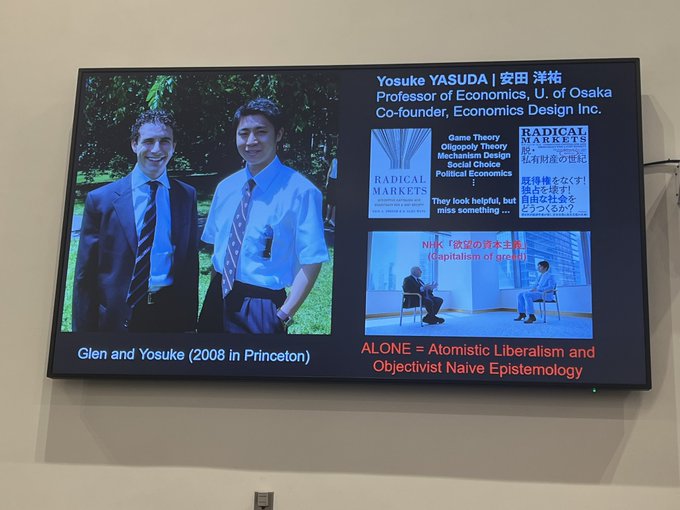
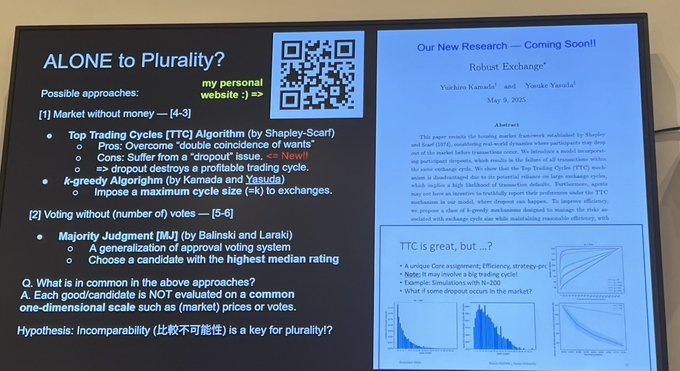
takerunakao From democracy and the constitution, AI use in politics, AI Agent to web3 and Deep Funding topics! #TokyoPluralityWeek
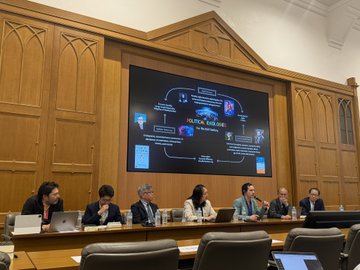
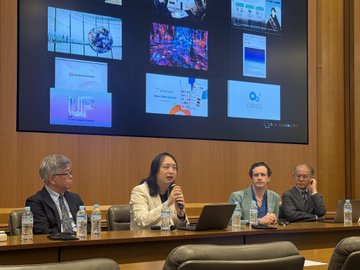
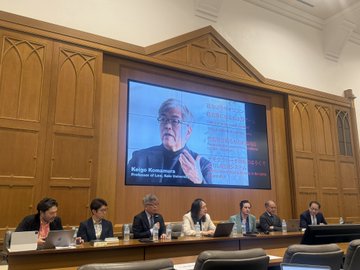
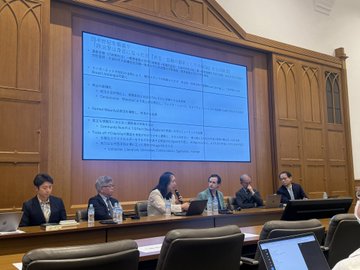
uchida_tomato I dare to be dry w because everyone is praising everyone else (I personally sympathize deeply). You say "Plurality" but the words you use are too difficult. I am worried that this will deepen the division of society. With such a wonderful group of talents, it should be possible to express difficult things in an easy-to-understand way. #TokyoPluralityWeek uchida_tomato I think there are too many references to past literature and great people (although I understand the sentiment). This is no different from academic societies (academic societies have their own value, but I don't think it fits with Plrurality because of the (inevitable) exclusive element of academic societies). 0xtkgshn I know! Please! Please do! uchida_tomato I'm not going to ask you to do this, but w I think I saw the discomfort I've been feeling all day today (continued) uchida_tomato The May 10 meeting was very interesting but uncomfortable. The point of today's discussion was that the product out-like innocence that "we 'should' all use the tools and ideas we discuss and try out because 'I'm not sure, but I'm sure it will be an improvement over what we have now'" was strongly felt beyond limits (continued). #TokyoPluralityWeek uchida_tomato In other words, it starts with "there is room for improvement in today's society (→I agree)" but does not specify the pain point or what it will look like after the improvement. In other words, it starts with "there is room for improvement in today's society" (→ I agree), but without specifying the pain point or what it will look like after the improvement. In the book, various approaches were listed, so I didn't feel a strong sense of discomfort, but in hindsight, I feel the same way (continued). uchida_tomato "Are you in a negative position?" I don't think so. In a sense, what the Ishitaka project is aiming for is the same as Plurality. However, if new opinion aggregation and new resource allocation are realized, which problems will be improved and in what way? The logical structure of the project would be uchida_tomato I want to solve these problems in front of me (putting aside what will happen), but I felt it was not issue driven (so I felt uncomfortable) as to what is the best (close to) tool to transcend the obstacles. I felt that the issue was not issue-driven (so I felt uncomfortable) (continued) uchida_tomato I also noticed again that the reason why the practical examples in Taiwan are clear is because they show a set of applied methods and the results of improvement after application. I noticed that. The improvement measures using AI discussed today can also be seen as only a discussion of how, since it is not shown what the value measure to be realized by AI will be (continued) uchida_tomato I know I laid out a lot of negative things, but I thought it best to accumulate success stories, even if they are small, and not trial examples. The ones that say, "I could do this" if I used this method. Not "I can do this." Of course, I think this discussion is also worthwhile because even in the conception stage, we need to discuss (continued) uchida_tomato In fact, I think some of the examples were presented as success stories. However, as soon as we hope to "reach a consensus" and "improve the situation as expected by the consensus" as "building community consensus while allowing diversity", diversity may be lost (consensus may be a different concept from diversity in the first place) (continued) uchida_tomato, I felt (again) that we have to think from a fairly abstract point of view, but if we don't set it with concrete examples of improvement, it will not be convincing. I have a dilemma....
Uchida wanted to think further about the field of finance & blockchain as a starting point.
It was a good meeting. Thanks to the staff (end) 0xtkgshn
cactaceae I'd like to hold a reading group and other activities to deepen my understanding of this to make the language easier to understand!
uchida_tomato: ... Plurality, but the words you use are too difficult. I am worried that this will only deepen the division of society. Since you have such a wonderful group of talents, it should be possible to express difficult things in an easy-to-understand way.
nishio Question! #TokyoPluralityWeek
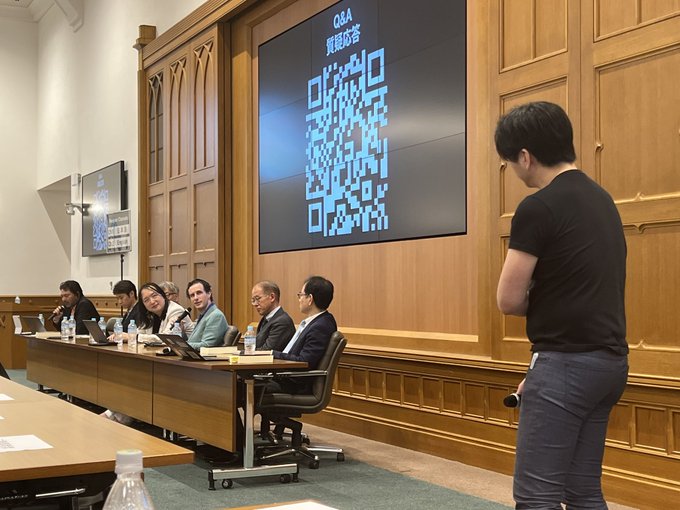
cactaceae "non-binary in all things" I'm that too! #TokyoPluralityWeek
mariroom Be a pollinator for Plurality ⿻
#TokyoPluralityWeek with @audreyt
Become a multiple pollinator ⿻
@audreyt #TokyoPluralityWeek
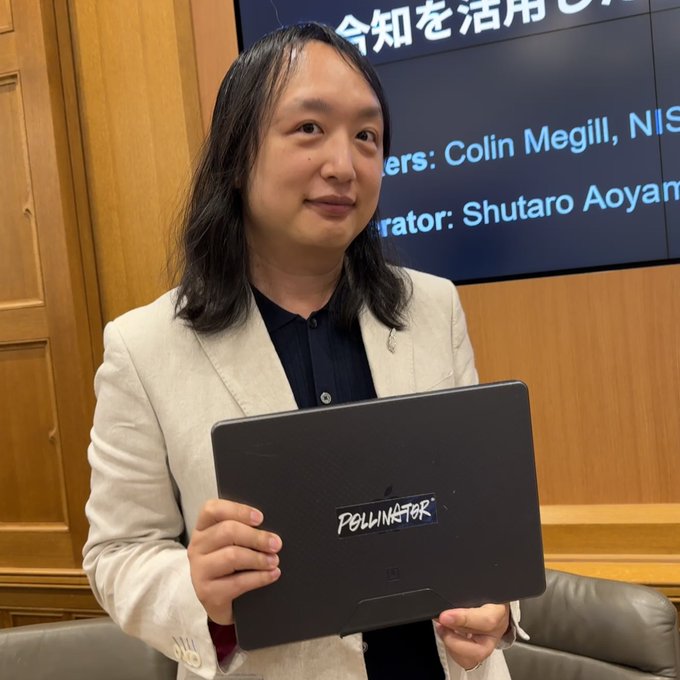
Parascorpaena I wonder if these technologies provide glasses to help decision makers. #TokyoPluralityWeek
mariroom Can you speak and vote with a public mindset?
I think it is important to make decisions with this "public mindset" or not.
#TokyoPluralityWeek
mtane0412 Colin blows up at question about relationship between polis and Eva #TokyoPluralityWeek
0xshj_jp Colin from Pol.is talking about Eva's MAGI w
plurality_book Visualize that opinions differ even within the same political party
@nishio Presentation by Mr. (in part) #TokyoPluralityWeek
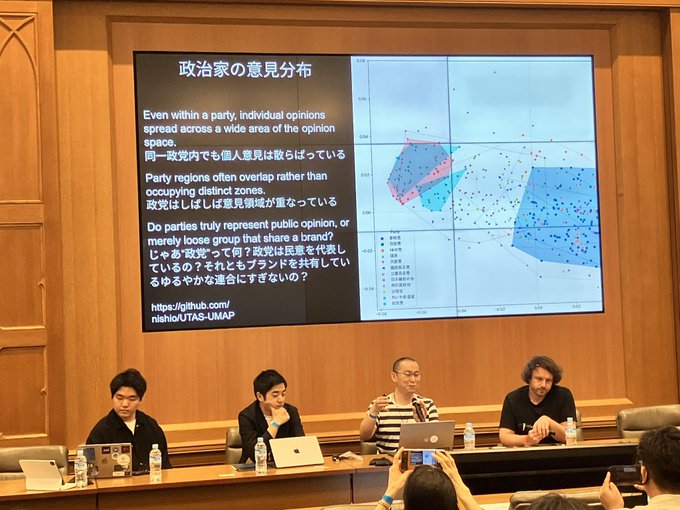
kensuzuki http://Pol.isの開発者のColinが, I am doing session 1 of Plurality Namerakaigi at Keio. Nishio-san's presentation is interesting. cactaceae Nishio's story is a good one for understanding Plurarity.
mariroom It was a brilliant session discussing Plurality from political, legal, and economic perspectives. What truly moved me, though, was Audrey’s closing remark about the importance of design and art. I felt a great sense of relief :) #TokyoPluralityWeek The session talked about Plurality from a political, legal and economic perspective. It was great, but I was very relieved when Audrey talked about the importance of design and art at the end.
I think the only way to bridge the gap between those who see the potential of Plurality and the rest of the population is to "make it and show it". I thought that the only way to bridge the gap between those who see the potential of Plurality and the rest is to "make and show. I think that this is a concept that should be explored in a variety of ways. I am also hopeful that many of the participants will be people who make things.
etokiwa999 Misinformation, but it is actually a topic that has attracted so much attention that it is ranked 4th in the World Economic Forum's "Global Risks Report," and in Japan it is being studied in the field of "computational social science In Japan, research is being conducted in the field of "Computational Social Science". https://css-japan.com #TokyoPluralityWeek
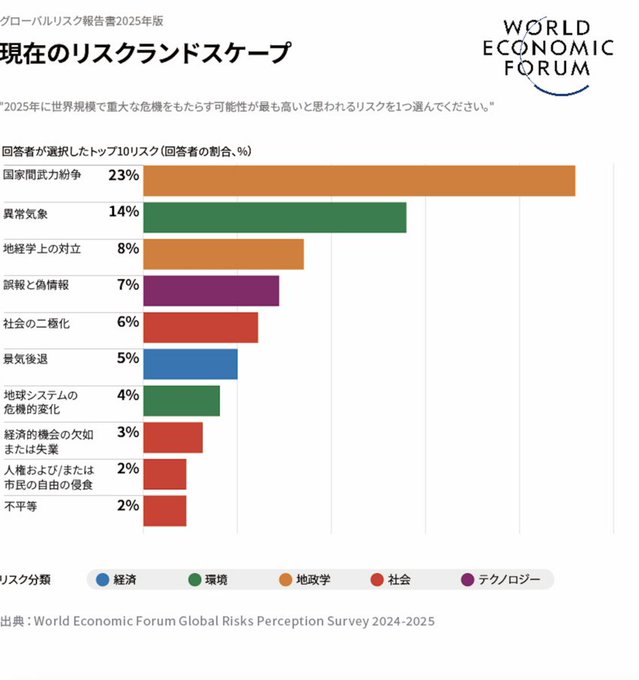
kensuzuki Audrey to attend session on disinformation
ktsuyu2525 Language itself must have a limit to recognize "smoothness". (For example, it is difficult for language to describe smooth changes from moment to moment, such as the shimmering of a river) #TokyoPluralityWeek Language is an information compression device and is intermittent. I think a quick thought to overcome this is.
- Continue to fill language gaps with new languages ↓ ktsuyu2525 2) Use marginal language with metaphors, etc.
- Develop communication tools that are good at describing a continuum of alternatives to language was considered. However, as for 3, people's linguistic cognitive processing is not good at processing continuous things, so a transformation of people's information processing is also required. ktsuyu2525 I was wondering if it would be possible to apply the research I presented at the HCI international conference, "Can fluid simulation be used to express and communicate ambiguous emotions in an ambiguous way? I wonder if it could be applied to my research on "Can fluid simulation be used to express and communicate ambiguous emotions in an ambiguous way? Emotion Overflow: an Interactive System to Represent Emotion with Fluid | Adjunct Proceedings of... Emotion Overflow: An Interactive System for Expressing Emotions in Fluid Form |Attached Proceedings of the...
sanjrow Nishio: "The enhanced ability of humans to understand others smoothes social boundaries."
etokiwa999 I'm on site. I'm wondering if the Plurality technology will help them by mildly picking up the voices of the poor who have been left behind, rather than dividing them.
Parascorpaena I wonder if these technologies provide glasses to help decision makers. #TokyoPluralityWeek
cactaceae "Taiwan has limited ability to transmit information, so we will practice in Japan and transmit it to the world" I think all Asian countries should go for this! #TokyoPluralityWeek
higu_yuu Is this what you were just talking about in Utah? Aki_laid_back DCA? Is it this way?
pro_jectliberty Utah Governor
@SpencerJCox
and Project Liberty Founder Frank McCourt co-authored a piece in
@TIME
on Utah's groundbreaking new Digital Choice Act giving people agency over their data on social media platforms.
Governor of Utah
@SpencerJCox
and Frank McCourt, founder of Project Liberty,
@TIME
In 2006, I co-authored an article on Utah's revolutionary new digital choice method.
- Social Media Platforms Shouldn't Own Your Identity | TIME
higu_yuu This is it! Thank you!
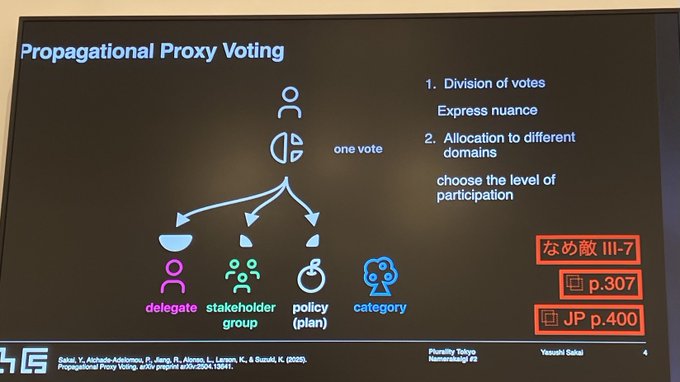
nishio "How many pages does this concept say in the Plurality book?" is compact, this notation is an invention w #TokyoPluralityWeek
Parascorpaena Lewis Carroll's career was like this.
- Lewis Carroll - Wikipedia
cactaceae The only name known in Japan is Lewis Carroll #TokyoPluralityWeek
takerunakao session2: Consensus building using collective knowledge, and session3: Fighting false information. Both thematic sessions discussed the current status of medium- and long-term issues being addressed and positive prospects for the future. #TokyoPluralityWeek
takerunakao session4: democratic allocation of funds theme discussion, OSS "Toban-Toban - as a theoretical and practical example" ( @0xtoban ) and DigDAO Matching Donations ( @digdaox ) was introduced! #TokyoPluralityWeek
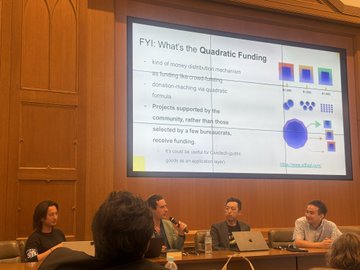
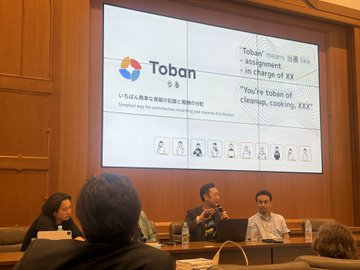
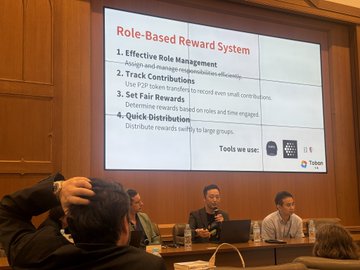
- Toban - a tool for recording contributions and distributing rewards
heat_1nt "Bonsai", a new method for visualizing and analyzing high-dimensional data with almost no distortion using structure.
DucheneJohan Popular methods like UMAP & t-SNE are stochastic and distort data structure.
Bonsai - a novel method - builds trees to relate high-dimensional objects, accounting for measurement noise.
https://biorxiv.org/content/10.1101/2025.05.08.652944v1… Common methods such as UMAP and t-SNE are probabilistic and distort the data structure.
Bonsai is a new way to construct trees that relate objects in higher dimensions and account for measurement noise.
https:// biorxiv.org/content/10.1101/2025.05.08.652944v1...
heat_1nt Bonsai x Broad Listening looks like a great match. Scalability is good, semantic distance and time-series change are obvious with branch length, and the structure is intuitive. heat_1nt I can upload the data and try it out. https://bonsai.unibas.ch/bonsai/ GitHub is here https://github.com/dhdegroot/Bonsai-data-representation healthy_sato I put this together in a messy way because I was curious! /plurality-japanese/Bonsai-scout
uchida_tomato I agree with the opinion that we need to utilize KYC and have literacy. I agree with the opinion that KYC and literacy are necessary. (Furthermore, I don't feel comfortable discussing correct information and false information based on binary values, as there is the problem of interpretation of the same information.) #TokyoPluralityWeek
etokiwa999 "Broad listening improves understanding of others," the presentation says, but that's too simplistic. First of all, we know that people's opinions don't change depending on the media, as we know from the Erie study, the Nazi propaganda study, and the Meta study. I think it is the politicians and administrative staff that will have a better understanding at 100 steps. #TokyoPluralityWeek etokiwa999 Here is an article explaining those studies
What is the Erie Survey? Votes are influenced more by friends than media https://sunblaze.jp/5276/the-erie-study/…
The Limits of Propaganda: Explaining the Nazis' Use of the Media Thesis https://sunblaze.jp/5277/propaganda-and-radio/…
What does social networking have to do with politics? Algorithms don't have the power to change opinions
nishio Is broad listening a medium?
cactaceae Interesting perspective. I find it media-like, but with some UX ingenuity you might be able to create the illusion of a friend!
nishio I feel that this is a good opening to dig deeper and find something interesting!
etokiwa999 The result of the broad listening and analysis is the information (content), and the information was mediated (media) is the broad listening? I think.
At least in prior research, we cannot find verified results that "the results of analysis of other people's opinions" influence people's decision making. chekichekimusu1 Sure. I'm going to have trouble visualizing what kind of input is influencing the self-awareness that's needed, if it's not there first.
etokiwa999 Misinformation, disinformation and conspiracy theories are equally "media" Again, that the media does not influence opinion formation, We know this from the Erie study, the Nazi propaganda study, and the Meta study. Not that the information on the internet is influencing them, Economic dissatisfaction and friendships have more influence on media choices. #TokyoPluralityWeek cactaceae Then maybe it means that pre-modern grassroots political activism is effective! etokiwa999 That (grassroots activism = demonstrations, visits, phone calls, etc.?) I'd like to find a paper on that, since it's a different point of discussion.
nishio "AI engineer, science fiction author, and recently became a party leader" I almost blow coffee when I introduce myself that way w/ #TokyoPluralityWeek
nishio "Broadly speaking AI, in a larger sense, the algorithms are the same" means the same in a very broad sense #TokyoPluralityWeek
nishio Digital Public Goods www #TokyoPluralityWeek
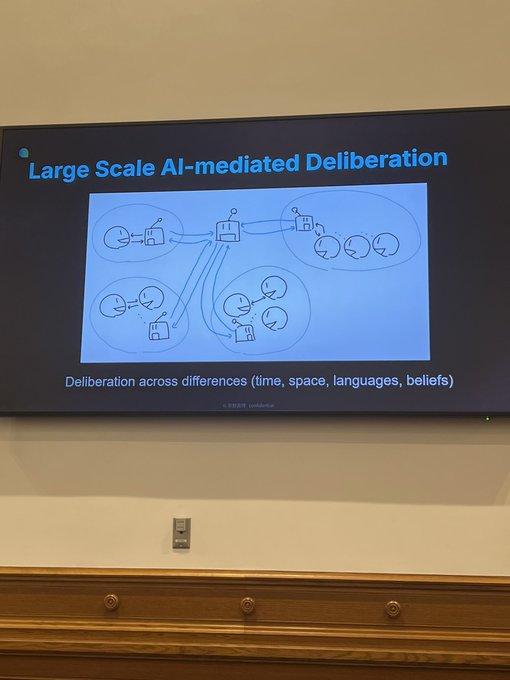
[/ishibashi/Plurarity Tokyo Session1 Slido question](https://scrapbox.io/ishibashi/Plurarity Tokyo Session1 Slido question). [/ishibashi/Plurarity Tokyo Session2 Slido Question](https://scrapbox.io/ishibashi/Plurarity Tokyo Session2 Slido Question). [/ishibashi/Plurarity Tokyo Session3 Slido question](https://scrapbox.io/ishibashi/Plurarity Tokyo Session3 Slido question). [/ishibashi/Plurarity Tokyo Session4 Slido question](https://scrapbox.io/ishibashi/Plurarity Tokyo Session4 Slido question). [/ishibashi/Plurarity Tokyo Session5 Slido question](https://scrapbox.io/ishibashi/Plurarity Tokyo Session5 Slido question).
annotakahiro24 Anno's speaking session has started! Please take a look!
17:20-18:00 Session 5 Will AI Evolve Democracy? Hijitaro Aoyama (blu3mo), Colin Megill, Audrey Tang, Takahiro Yasuno. Moderator: Akinori Oyama
Plurality Tokyo Namerakaigi #2 https://youtube.com/live/s_e3kMzjF8M?si=3cOwhPNyn66qVNEf… #TokyoPluralityWeekyoutube.com Plurality Tokyo Namerakaigi #2 "Plurality Book Japanese edition" publication commemoration collaboration... Plurality Tokyo Nameraka Igi #2 "Plurality Book Japanese edition" publication commemoration collaboration... With translations: https://youtube.com/live/o8IGqBxb3Ho?feature=shareイベント概要台湾のデジタル大臣として活躍したオードリー and economist Glenn Weil, known for his radical market design Plurality: The Future o...
annotakahiro24 *Simultaneous translation version is here youtube.com Translation ver Plurality Tokyo Namerakaigi #2 collaboration with... translation ver Plurality Tokyo Nameraka Igi #2 Collaboration... Event SummaryAudrey Tan, Taiwan's former Minister of Digital, and Glenn Weil, an economist known for his radical market design, have co-authored "Plurality: The Future of Collaborative Technology and Democracy", co-authored by Audrey Tan, Taiwan's Minister of Digital Affairs, and Glenn Weil, an economist known for his radical market design, will be held at the "PLURALITY: The Future of Collaborative Technology and...
nishio I remember "school starts later" type stories showing up in thinTokyo2050. w #TokyoPluralityWeek
nishio "You can't show slides, you need to demonstrate a prototype" #TokyoPluralityWeek
nishio If you send out information about where you stumbled on something that was difficult or hard to understand, it is a social contribution because it creates an opportunity for those who understand to teach. The people who understand don't know what the people who don't understand don't understand, so it is necessary to teach them first. Of course, the person who teaches them afterwards also contributes to society. #TokyoPluralityWeek
0xtkgshn It would be more helpful if you blogged about it rather than tweeting about it so I can refute and repurpose it. You tweet and that's it? Is it okay to just throw a low-resolution blur out there with one hand at random and act like you've objected to whatever it is? I'm happy either way, whether I hate it like crazy or love it like crazy, but the middle is evil #TokyoPluralityWeek
nishio "I think the session was too interesting to tweet, so go home and post pictures and thoughts" #TokyoPluralityWeek
cactaceae I made a Togetter. The name of the service was changed. Plurality Tokyo - posfie #TokyoPluralityWeek cactaceae I've left it open for anyone to edit, so feel free to submit it!
moriteppei Plurarity is the word for "politics is wack" and "mere democracy is the same as populism", and we all come to Audrey Tan and say "yeah, yeah". The division is progressing between those who are doing the "yes" and those who don't know such things at all.
- This is a problem that needs to be solved.
- That's why they publish books and do events.
nishio #TokyoPluralityWeek The world has been aware of the disinformation problem since Brexit and Trump's victory in 2016. It was interesting to hear that Japan felt as if it was a fire on the other side of the river, but the same trend can be seen overseas in the spread of summary websites on social networking sites. The same problem occurred, but we realized it too late.
ninofku Plurality Tokyo Namerakaigi #2 It was great!
I was greatly inspired not only by the two authors' stories, but also by their ideological backgrounds such as Tocqueville, the history of deliberation in Japan, the current state of social implementation, etc.
I would like to boost the community so that Japan can become a new center of democracy, and I will start doing something hands-on within Chuo Ward.
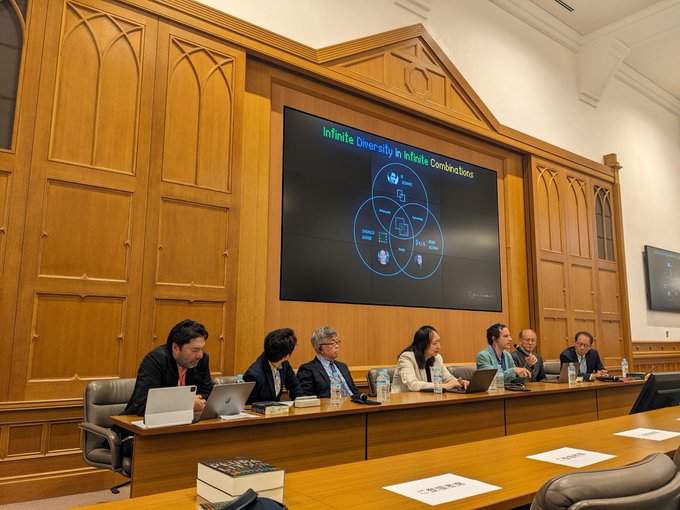
ninofku There is also an archive of the stream on Youtube if you're interested. it's over 5 hours long, so take a little bit at a time. youtube.com Plurality Tokyo Namerakaigi #2 "Plurality Book Japanese edition" publication commemoration collaboration... Plurality Tokyo Nameraka Igi #2 "Plurality Book Japanese edition" publication commemoration collaboration... With translations: https://youtube.com/live/o8IGqBxb3Ho?feature=shareイベント概要台湾のデジタル大臣として活躍したオードリー and economist Glenn Weil, known for his radical market design Plurality: The Future o...
toufu_qbota Institutional design in the political domain is about how to quantify, extract, evaluate, and implement the principles of human behavior (decision making) in an abstracted form. This is why I learned yesterday that even though it is a humanities field, it is compatible with the thinking of engineers.
#TokyoPluralityWeek
RomaKumakura archives. I was very interested in Shigenori Uno's suggestion that "fandom is a modern association. I did not have that perspective...
katsunobu1008 He was blabbering on about Eva's MAGI. Caspar, Balthazar, Melchior The story of a computer named after the Three Wise Men of the East in
I had never thought of MAGI in terms of democratic consensus building!
I was more sympathetic to your love of Eva!
@colinmegill
#TokyoPluralityWeek
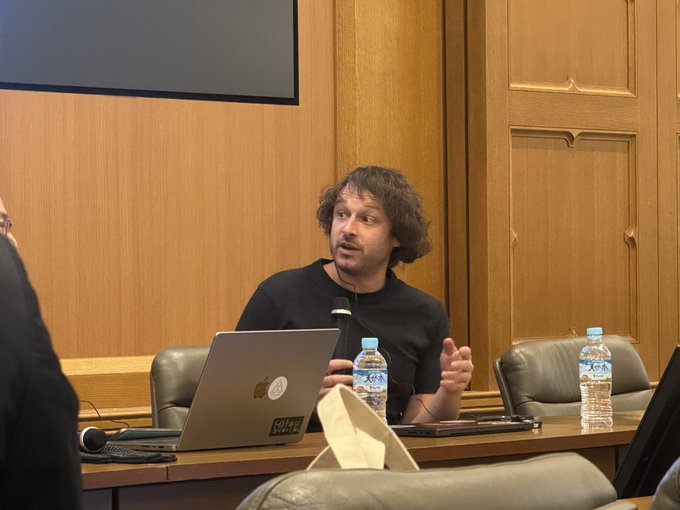
takahiroanno Yesterday, I attended a talk session at Plurality Tokyo on "Will AI Evolve Democracy? I attended a talk session called "Will AI Evolve Democracy? I was joined by Audrey Tan from Taiwan, Colin Megill from Polis, Bluemo, and Akinori Oyama! blu3mo Plurality Tokyo Session 5: Will AI Evolve Democracy? Panelists: Taro Aoyama Hiiragi, Colin Megill, Audrey Tang, Takahiro Yasuno / Moderator: Akinori Oyama
I was on the stage... I introduced the story of the Digital Democracy 2030 community project, among others! #TokyoPluralityWeek
This page is auto-translated from [/nishio/Plurality Tokyo Namerakaigi #2](https://scrapbox.io/nishio/Plurality Tokyo Namerakaigi #2) using DeepL. If you looks something interesting but the auto-translated English is not good enough to understand it, feel free to let me know at @nishio_en. I'm very happy to spread my thought to non-Japanese readers.