Evergreen Notes
- Living Text metaphor corresponding to "dead tree" as a metaphor for [dead text
Evergreen notes (DeepL-ed) Evergreen note (evergreen note)
Evergreen notes are written and organized to evolve, contribute, and accumulate over time.
This is an unusual way of thinking about writing notes.
This is because most people only take Temporary note.
Because these practices are not about writing notes, but about developing insights effectively.
- [Good note-taking misses the point; what matters is good thinking.
Making better notes is not important; it is "better thinking" that is important.
Hopefully, these notes will be of great value.
Evergreen note writing is the basic unit of knowledge work.
It is difficult to write notes that are worth taking the time to develop. This principle helps. - Evergreen notes should be atomic. - Evergreen notes should be conceptually oriented. - Evergreen notes must be closely linked - Prefer associative ontology over hierarchical taxonomy 。 - Write notes for yourself by default and ignore the reader.
This concept evolved from Niklas Luhmann's "Zetterkasten," which he positions as an independent intellectual partner in the writing of his 70 books.
- See similarities and differences between Evergreen Note Writing and Zettelkasten
Evergreen Notebook Practices
- Write what you read to deeply internalize the text
- A reading inbox is used to store useful references.
- Writing-in boxes for temporary or incomplete notes
- Actionable Strategies for Writing
relevance - New shoots have sprouted from dead trees - rootless grass - Seeds that fell on stony ground sprouted quickly but died because they had no roots
shokai Evergreen note interesting. Me.
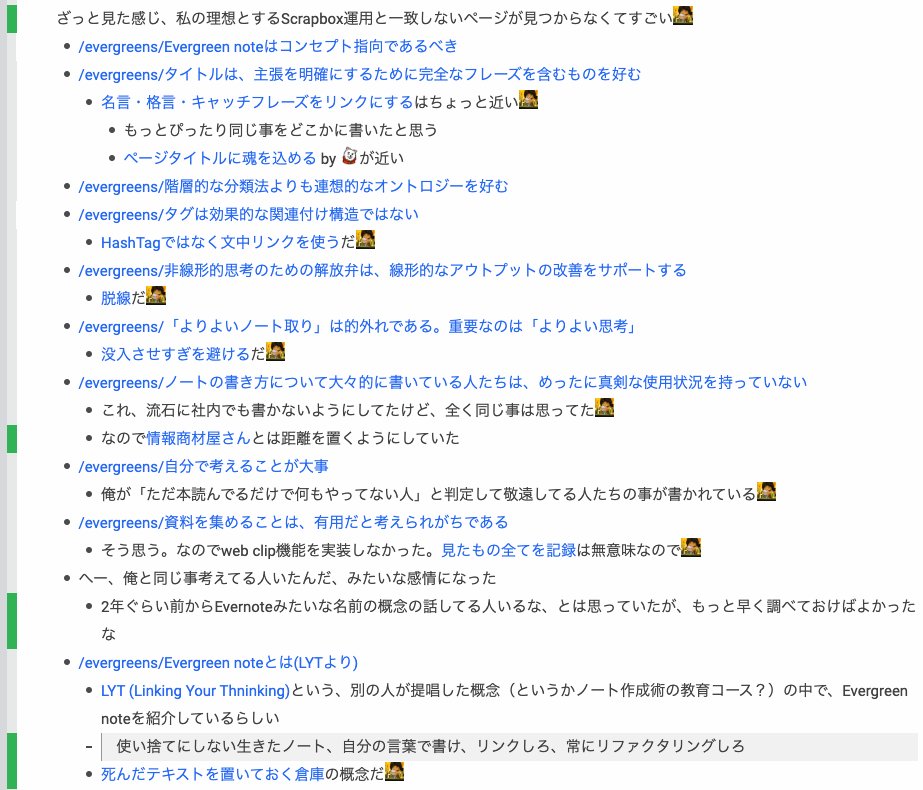
shokai [/evergreens/Evergreen note Impressions
shokai I laughed when he even vomited the poison he had filtered through his societal filter and didn't vomit.
This page is auto-translated from /nishio/常緑のノート using DeepL. If you looks something interesting but the auto-translated English is not good enough to understand it, feel free to let me know at @nishio_en. I'm very happy to spread my thought to non-Japanese readers. Evergreen Notes see Evergreen Notes
This page is auto-translated from [/nishio/Evergreen Notes](https://scrapbox.io/nishio/Evergreen Notes) using DeepL. If you looks something interesting but the auto-translated English is not good enough to understand it, feel free to let me know at @nishio_en. I'm very happy to spread my thought to non-Japanese readers.