The University of Tokyo Plurality Seminar 2025-05-12
Tokyo College Seminar on ”Plurality: the Future of Collaborative Technology and Democracy” May 12 Tokyo College Seminar on "Plurality: the Future of Collaborative Technology and Democracy"
- Cast: Audrey Tan, Glenn Weil, Takeo Hoshi, Takehito Kojima, Ken Suzuki, and others
- Date and Time: May 12, 2025, 3:00 p.m. - 4:40 p.m.
- Place: Fukutake Hall, Hongo Campus, The University of Tokyo
- Format: Researchers only by full invitation, free of charge, archived distribution available, English only
- Organized by Tokyo College, The University of Tokyo
Summary (via audio, so not sure of people's names)
nishio #TokyoPluralityWeek Todai Now!
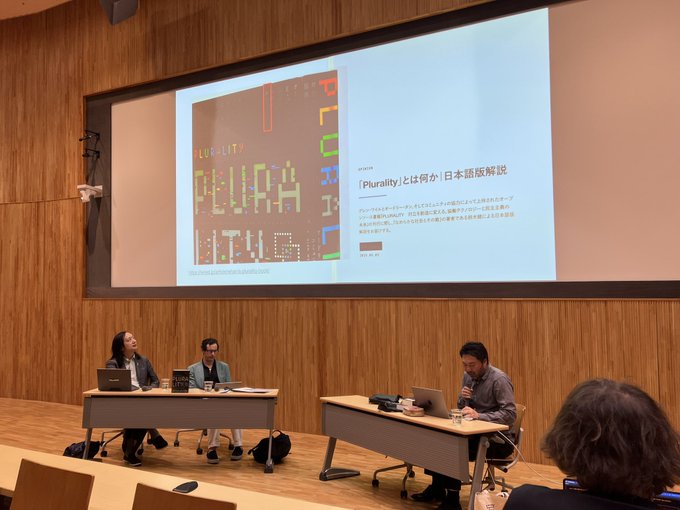
The event began with opening remarks by Ken Suzuki. He introduced the background of the conference as the publication of the Japanese edition of the book "Plurality," co-authored by Taiwan's Minister of Digital Affairs Audrey Tan and economist Glenn Weil. Ken Suzuki himself wrote a commentary on this Japanese edition, and he took the stage to introduce the concept of Plurality.
Ken Suzuki explained that the concept of Plurality comes from the idea in Hannah Arendt.'s "The Human Condition" that "people are equal in the sense that they are different, which brings about political reality. He then emphasized that plurality is a technology for cooperation across social differences and not an abstract concept.
nishio Ken Suzuki "This is the most important figure in the book!" #TokyoPluralityWeek
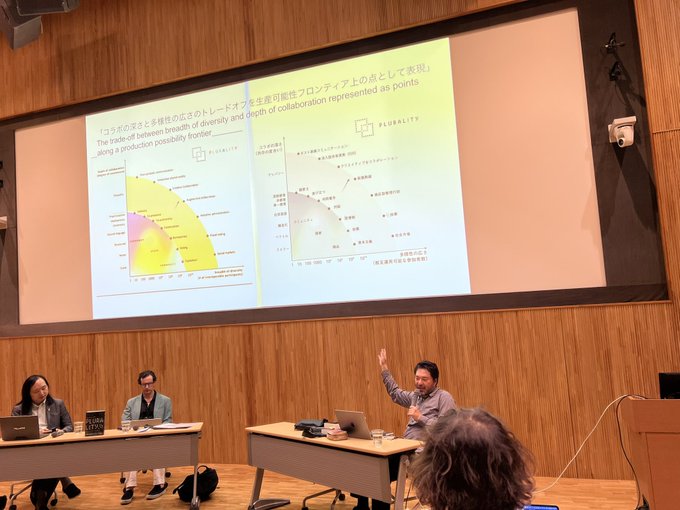
As an important point of the book, he presented a chart showing the tradeoff between "Breadth of Diversity" and "Depth of Collaboration. He stated that the core concept of Plurality is the ability to extend this production possibility frontier further by using technology in the case of shallow collaboration with many people (bottom right) and deep collaboration with a small number of people (top left), as in the case of a currency system. The core concept of Plurality is the ability to further extend this production possibility frontier through the use of technology.
nishio Three Ideologies Landing in the Japanese Context by Ken Suzuki #TokyoPluralityWeek
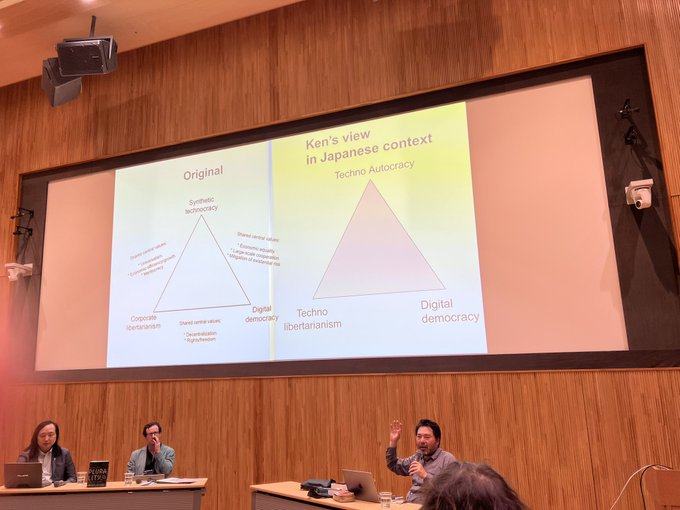
He also mentioned the two prevailing ideas about technology, Synthetic Technocracy (represented by OpenAI, etc.) and Corporate Libertarianism (represented by Bitcoin, Web3, etc.), and explained that Plurality, in this context, is He explained that Plurality is trying to establish a third way. Ken Suzuki expressed the view that in the Japanese context, synthetic technocracy could be transformed into Techno-Autocracy (represented by neighboring powers), and that Techno-Libertarianism corresponds to the current US tech giants.
The next speaker was Glenn Weil. He noted that times are changing and that many of the certainties of the era in which he grew up are coming to an end in terms of international relations, views on democracy, and relationships with technology. He noted that technology is increasingly seen as a threat in the West. He criticized the dominant ideology of techno-libertarianism, which preaches that "blockchain frees us from the need for mutual care, cooperation, and government," and synthetic technocracy, which preaches that "machines do it all." Plurality used the example of Taiwan's digital democracy to show how the citizen hacker movement (g0v) helped improve government digital services and build the digital infrastructure to achieve the world's best results in fighting the novel coronavirus. In Taiwan, consensus building on controversial issues (marriage equality, Uber, etc.) was achieved using tools that cut across social divisions, and not only biological but also informational infections (disinformation) achieved despite a diverse and complex society, where differences flare up in conflict He stated that the Plurality concept shows that by building the right engines, that energy can be harnessed for growth and development, rather than exploding into a

Mr. Glenn gave the following examples of specific mechanisms of Plurality: - A "Plurality" is a group of people who are given the opportunity to work with a group of people who have been given the opportunity to work together. - pro-social media: Provides social context for users by labeling online content with labels indicating its acceptance within a community, as determined by an algorithm, to promote consensus building across divides. It is funded through a business model that charges social communities for higher rankings of agreed-upon content in their member feeds.
- Digital Democracy Platform: a platform that leverages Taiwanese tools to allow citizens to raise important issues (e.g., Engaged California).
- Quadratic Voting: A voting system that allows for a statement of importance. Used in Colorado and Taiwan for budget allocation.
- Quadratic Funding (secondary funding): a system in which individual contributions to a project are funded from a matching pool based on the diversity of those who contributed. Hundreds of millions of dollars have been distributed.
- Digital Public Infrastructure: Governments fund the development of open source digital infrastructure by the civil sector to become the default in public sector applications (e.g., India Stack). This will broaden access to payment, identity, and e-commerce systems and avoid platform monopolies.
- Partial Common Property Systems: A system in which ownership is not absolute and taxation is based on self-assessed value and consent to sale at that value. It promotes economic use while creating a sharing of rights.
- Related Partial Common Ownership.
Glenn said he believes Japan is the most prepared place in the world for these ideas to become mainstream and help make Japan a world leader. Glenn also spoke at the Designing the Future Conference (Future Design Councils), Citizens' Assemblies, AI augmented broad listening, the National Museum of Emerging Science and Innovation (Miraikan), Team Labs (Miraikan), and the National Museum of Emerging Science and Innovation (Miraikan). of Emerging Science and Innovation] (Miraikan), cultural institutions such as Team Labs (Team Labs), and a dynamic private sector promoting new digital technology development models for the public good ([Sushi Tech Tokyo ), Startup Shibuya, SmartNews, Cybozu, Sakana.ai, and others.
Here, a short film (trailer) by Audrey Tan was shown. The film touched on the world situation where democracy is in decline and authoritarianism is on the rise, showing that the Sunflower Movement in Taiwan can evolve democracy and that democracy should be seen as a "social technology" that allows people to build and improve political systems together. He also spoke about his own experience with a heart defect. He also warned that, based on his own experience with a heart defect, he is aware that everything is resettable and that we can easily lose our democracy. He introduced Taiwan as a place where, unlike the United States, which runs on an old operating system (250 years old), we can rethink what democracy should look like in the 21st century, and that by making the government public and providing easy access to data, Taiwan has become the most exciting constitutional democracy in the world.
- Trailer for [/plurality-japanese/Good Enough Ancestor](https://scrapbox.io/plurality-japanese/Good Enough Ancestor): [/plurality-japanese/Japanese translation: Good Enough Ancestor (Trailer)#664b0c3eaff09e0000fc0402](https://scrapbox.io/plurality-japanese/Japanese translation: Good Enough Ancestor (Trailer)#664b0c3eaff09e0000fc0402)
After the screening, Audrey Tan gave a short message to the audience. He emphasized that "society and its enemies" and "indifference" are the enemies of Plurality and the digital democracy project. He concluded by saying that if indifference is the enemy, then difference is our ally, and that these technologies are for celebrating difference, nurturing difference, and leveraging difference for better co-creation.
From here, the session moved to a question-and-answer session, beginning with a question to Audrey Tan.
Balancing Transparency and Privacy Protection: While acknowledging the importance of transparency in the Plurality philosophy, the questioner (Prof. Kojima) pointed out the difficulty of balancing transparency with privacy protection, and asked how the success of information sharing in Taiwan in fighting the novel coronavirus (especially in mask and vaccine distribution) has asked how the success of information sharing in Taiwan's response to the new coronavirus (especially in mask and vaccine distribution) overcame privacy concerns.
Audrey Tan responded technically, explaining that Taiwan's contact tracking system was based on scanning a QR code at the venue or sending an SMS with a 15-digit number. He stated that this system avoided the trade-off between privacy and public health by having the following three characteristics
- the venue does not learn anything: it only indicates that you have texted 1922 and no phone numbers, etc. are known.
- carriers get no new information: they don't know what a random number corresponds to and already have rough location information.
- the state learns nothing: unless there is an outbreak in the region, the state cannot see the data.
- This is important, he emphasized, because it only needed to be amplified as multi-party storage zero knowledge proof civil society (activists such as GovZero) "civic infrastructure.
Diversity and Harmony in Japanese Culture: Another questioner (Prof. Emma) felt that while Plurality preached the importance of diversity, Japanese culture tended to emphasize harmony and sameness, and asked how this Japanese culture was viewed and how to strike a balance between diversity and harmony. He asked the following questions.
Audrey Tan explained that pro-social media efforts are not about eliminating or censoring extreme views, but about making visible "uncommon ground" and "[rarely discovered middle ground )" rather than to visualize "uncommon ground" or "rarely discovered middle ground".
By presenting viewpoints such as "up wing" (up wing), which are supported by both left and right by the algorithm, and by showing that polarized views are not actually dominant, facilitating bridging and giving "bridging bonus" (bridging bonus), He stated that they have put in place a system that favors those who connect different communities.
- This part is.Birdwatchの図を見るとわかりやすくて、left wing / right wing ではなく両側から支持されているup wingを可視化しているというわけ
- This part is.Birdwatchの図を見るとわかりやすくて、left wing / right wing ではなく両側から支持されているup wingを可視化しているというわけ
He noted that Taiwan has used this "cross-sectoral divide" and bridging bonus concept to significantly improve public confidence levels in controversial social issues such as marriage equality and Uber.
Digitization, mode of production, and economic disparity: Another questioner pointed out that Plurality's push for digitization risks widening the economic gap between countries that can produce digital products and those that produce raw materials, and asked how a digitized democracy would confront this mode of production issue. He questioned how digitalized democracies would deal with this mode of production issue.
Audrey Tan stated that in Taiwan, digital infrastructure is seen as part of the socialist core. She explained that broadband, like universal health care and universal education, is defined as a human right and is considered something that should be placed outside the capitalist market.
He stated that in areas where there is no Internet access, there is a mechanism for the government to have telecommunications carriers provide universal service and reimburse other carriers for their losses. He argued that this is an approach that regulates digital technology very strictly as Utilities, rather than leaving it to market forces, and that social media should be included in this. He said that by requiring interoperability in social media, as in utilities, so that people can switch providers and still carry their phone numbers with them, it would prevent monopolization by large companies and create an environment where non-profits and small players could enter and compete in the marketplace. This is a solution to the problem of all modes of production. He said this would not solve the problem of all modes of production, but it would be a valid starting point for essential services.
Isolation due to remote work and digitization: one audience member expressed concern about people becoming increasingly remote and isolated due to digitization, such as remote work during pandemics and ways of working with little physical contact, and whether this should be seen as "fear" or "liberation", He asked how we think about this in terms of Plurality.
Audrey Tan said that the pandemic was an extreme example, and that many workplaces are moving to a hybrid model, explaining that tools like Zoom are good for converging, but not for diverging, and that the latter requires an " ambient awareness system" to understand what is going on around you, which is easier to do face-to-face. ambient awareness system]," which is easier in person. He noted that many companies are finding that a mix of in-person and remote work leads to a better work environment.
He explained that the Plurality initiative sees this not as a dilemma, but as a "productivity frontier. In other words, he said that technology can help "make shallow technology a little deeper" or "deep technology a little more inclusive" in response to the trade-off between deep with a small number of people or shallow with a large number of people. Augmented collective intelligence, he said, lies in the ability to move fluidly and flexibly between modalities, not just one mode or the other.
At this point, time ran out and the question and answer session with Audrey Tan ended.
Roundtable sessions followed. The title of the session was "The Political Economy of Technology and Inclusion," but free discussion beyond this was expected. The panelists were introduced as the moderator, Professor Naoko Shimazu (Vice President, Tokyo College; historian), Glenn Weil, Professor Takehito Kojima (Department of Economics, University of Tokyo; Market Design, Matching Theory, and Game Theory, Tokyo College), and Associate Professor Yusa Ema (AI and Social, Science and Technology Theory, Tokyo College and UT Future Vision Institute). The session began with Prof. Kojima and Associate Prof. Ema. The format was shown with Prof. Kojima and Associate Prof. Ema first commenting on Plurality's ideas, followed by Glenn's comments and an open Q&A session.
Professor Kojima made the first comment. He described his specialty, Market Design, as a field that uses mathematical techniques such as game theory to design social institutions (market and non-market). He noted that Glenn had been a major player in the market design field in the past.
- However, he felt that Weil's recent shift in emphasis beyond academic research to direct policy work "represents a technocratic approach in which experts build institutions from the top down," and as a fellow market design researcher, he is nervous that his work might be viewed in that way.
- Professor Kojima cited as an example the proposals for reform of Japan's public high school entrance examinations that his laboratory is working on. In response to the current "only one school can apply" system, which creates a great deal of stress and inefficiency for students, he introduced a proposal to introduce a "matching system" in which students submit their preferences and a computer tallies the results. He stated that this algorithm is a well-established one used in the U.S. and other countries.
- However, he explained that the proposal suddenly gained attention because he had the opportunity to explain it directly to key politicians, resulting in its mention by the Prime Minister.
- While he was pleased to have the opportunity for scholars to influence public policy, he raised the question of whether this is a less inclusive way to "whisper in the prince's ear" or if there is a more inclusive way, and asked for advice from Glenn and the audience on how the idea of Plurality could help to make such a proposal more He sought advice from Glenn and the audience on how Plurality could help promote such a proposal in a more inclusive way.
Glenn responded to Professor Kojima's comments by saying that there are two aspects that have changed his perspective.
- First, while economists tend to focus on "sub-modular" issues such as allocation (the assignment of fixed resources to people), I have come to believe that co-creation issues (collective choices about curriculum, school construction, policy decisions, etc.) are equally important. He noted that scarcity itself may be related to the fact that collective decisions are not being made in an ideal way.
- Second, the problem of co-creation is more difficult, and the goal is to achieve dramatic change (improvement from 1% to 5%) because it is difficult to approach the optimal solution. We stated that such changes cannot be achieved without citizen participation because they have a significant impact on people's lives and cannot be "sneaked through by a prince". He therefore spoke of the need for a completely different methodology for engagement and discussion to address such a major issue.
In response to Glenn's initial response, Professor Shimazu asked what Professor Kojima's case demonstrates about the issue of political participation, i.e., how it can influence policy, i.e., "how members of society can make policy proposals and promote them in a fair and efficient manner," and how Plurality's He further asked how the idea could bring about improvements.
Glenn responded to this question by emphasizing that the way Plurality's approach improves policy proposals and promotion is by focusing on group behavior and social matters rather than individual actions.
- As a result of its focus on quasi-modular issues such as quotas and private goods, economics has focused much of its attention on individual behavior, especially unique and self-interested behavior. This is due to economics' individualistic heritage and its difficulty in dealing with complexity.
- This "difficulty in dealing with complexity" is a nuance of the customary practice in economics in the past to reduce complexity by assuming that each individual is independent in creating mathematical models.
- This "difficulty in dealing with complexity" is a nuance of the customary practice in economics in the past to reduce complexity by assuming that each individual is independent in creating mathematical models.
- Plurality's approach, however, emphasizes group behavior and taking social matters into account, including understanding individuals as part of social relationships and culture.
- Glenn noted that this is an important distinction from his own previous approach (which included his earlier writings and focused on individual incentives).
- He spoke of the importance of thinking about social relationships and culture at the heart of what it means to be involved in participation.
- Thus, Glenn explained that Plurality improves policy proposals and how they are promoted not simply from the perspective of resource allocation and individual incentives, but through an approach that takes into account social relationships and culture and focuses on group behavior and co-creation.
- As a result of its focus on quasi-modular issues such as quotas and private goods, economics has focused much of its attention on individual behavior, especially unique and self-interested behavior. This is due to economics' individualistic heritage and its difficulty in dealing with complexity.
Associate Professor Ema followed with her comments. From her perspective as a social scientist, she acknowledged the importance of plurality, co-creation, and participation, but noted that some people are unable to participate due to accessibility issues. She expressed concern that people in areas with limited or no Internet connectivity (rural Japan and the Global South) or those without access to technology are "invisible" and their voices are not heard. He stated that this is an infrastructure issue and that the roles of the public and private sectors will be critical. Another challenge with Plurality, he said, is that there are a variety of people who do not want to be involved in the discussion and who do not recognize the value of diversity and inclusiveness. He pointed out the difficulty of how to approach those who do not want to accept the ideas and concepts of Plurality and how to deal with those who do not even have access to the technology. He asked about the scope of the Plurality concept, including how to approach those who do not want to accept the idea and concept of Plurality and how to address those who do not even have access to technology.
Glenn responded that inclusion means reaching out with love, care, empathy, and understanding, even to those who are perhaps the most difficult to embrace diversity. He stated that for a network to be strong and effective, it must reach less connected nodes and provide benefits to all.
- On the issue of accessibility, he explained that he has always insisted that digital public infrastructure be placed in the Transportation Committee rather than in the Congressional Research Committee. He stated that compared to roads, digital infrastructure is very inexpensive and that the Internet can be a way for those who are not physically mobile (especially the elderly) to connect with others for hobbies and other purposes.
- He said that Plurality is valuable even for those who want a smaller community, and that even within communities, such as white supremacists, divisions exist, and Plurality's tools are relevant to them as well. He said that while these practices and tools are relevant to all communities, not everyone bridges like "citizens of three countries," but the nature of diversity, where people are building bridges, is important.
- "No one needs to act like a 'citizen of three countries.' Rather, building bridges where each is different is at the heart of diversity."
- I am not familiar with the phrase "citizens of three countries / citizens of three worlds
- Biblical scholarship calls the New Testament Paul "a Jew, a Greek cultured man, and a Roman citizen -- a citizen of three worlds."
- "No one needs to act like a 'citizen of three countries.' Rather, building bridges where each is different is at the heart of diversity."
Prof. Shimazu asked about the role of technocrats and experts in a digital democracy. Pointing out that people may not be interested in participating and that knowledge is necessary to participate in policy discussions, he asked for thoughts on the role that experts should play, as it is difficult for everyone to become an expert.
Glenn cited the ideas of John Dewey, noting that he was responding to a debate with Walter Lippmann (arguing that industrial societies are too complex to be managed by democracy and require expert management).
- Based on his experience in China, Dewey said that "experts" have an absolutely critical role, but it is a bit different from what is usually thought of. Dewey saw the role of the expert as "recognizing" the new social community created by the new interdependencies created by the new technologies. He explained that democracy needed to be constantly reinvented, and that for Dewey, democracy was not about voting, but about people collectively governing their interdependencies. Since technology is constantly changing the nature of interdependence, the expert expressed the idea that it is necessary to identify these new forms of interdependence, create new populations, and allow these populations to self-govern once they recognize themselves. As an example, he said that the global warming issue has only become recognized through global statistical analysis, and that the role of the expert is not to impose his will as an expert on the issue, but to act as a mirror reflecting the new interdependent population.
Prof. Shimazu further reiterated the exclusionary nature of technology in an aging society (the potential for the younger generation who can use technology to take the lead) and asked what the ultimate goal of Plurality is, or whether this is an endless process, a socio-political movement.
Glenn stated that there are two contrasting ways of thinking about technology: Singularity / Plurality. One is the image of digging down from the surface of the sphere to the core of truth; the other is the image of planting trees on the surface of the sphere and letting them grow into the infinite void. In the latter case, if the trees are too far away from each other, they lose the ability to cross-pollinate, so a better method (bees, transportation, etc.) is needed; Plurality is this way of thinking, and I stated that the goal is not utopia. They said that nothing is more hopeless than utopia, and their goal is to be a "good enough ancestor. He explained that too good an ancestor constrains descendants, and an insufficient ancestor deprives them of opportunities, so they aim to be just good enough ancestors.
An audience member asked whether the pro-social media and digital space has been contaminated by bots and fake accounts, and whether it reflects the true will of the people.
Glenn stated that bots are only one form of attack, and that the more essential issue is authentication. He explained that the core of authentication lies in the idea of meronymy, which means that the parts represent the whole (e.g., your eyes are part of you). He stated that there are many ways to uniquely identify people, not only by legal name, but also by the places they have visited, the people they know, their faces, etc. The privacy problem lies in a simple system that uses the same identification method everywhere. He said that conceptually this is a very easy problem to solve and that more sophisticated data structures are needed.
- He pointed out that "authentication is a process of proving wholeness by showing only a part of the person (attributes, keys, biometric elements, etc.) without directly exposing the person = the whole," and that this idea of "the part representing the whole" is isomorphic to the linguistic term "meronymy" (part-whole relationship). This idea of "the part representing the whole" is isomorphic to what linguistics calls "meronymy" (part-whole relationship).
- Proof of being human をする上ではSNSに My Number Authentication をつけるだけでいいので技術的に簡単で、次に「プライバシーの問題が」となることを予見して「それは同じ番号をどこででも使うことが問題なのであり分散型IDシステムなどによって解決できるよね」というところまで一息で説明している感じ
- Proof of being human をする上ではSNSに My Number Authentication をつけるだけでいいので技術的に簡単で、次に「プライバシーの問題が」となることを予見して「それは同じ番号をどこででも使うことが問題なのであり分散型IDシステムなどによって解決できるよね」というところまで一息で説明している感じ
- He pointed out that "authentication is a process of proving wholeness by showing only a part of the person (attributes, keys, biometric elements, etc.) without directly exposing the person = the whole," and that this idea of "the part representing the whole" is isomorphic to the linguistic term "meronymy" (part-whole relationship). This idea of "the part representing the whole" is isomorphic to what linguistics calls "meronymy" (part-whole relationship).
As a final question, he asked whether Plurality's project is based on the assumption that the majority is willing and able to rationally pursue the public good, and how it views the reality (that the majority is not necessarily so) as Hannah Arendt criticized in "the banality of evil," and whether disinformation is deeply entrenched in society, and whether this approach is valid in a democratic society, and whether there can be a tipping point where that kind of majority disappears in a democratic society.
Mr. Glenn stated that the term "majority" is not important in Plurality.
- The key perspective is diversity.
- Plurality is not about majority rule in standard voting theory, but about understanding each other across the important divisions that exist.
- Historically, the idea of majority rule in a democracy was an attempt to achieve a "peaceful transfer of power. The idea was not to fight, but to allow the side with more numbers to get things done.
- However, a situation in which 49% and 51% switch back and forth along the same line is the worst possible way to provoke a civil war (civil war).
- The way to avoid civil war, he said, is "cross-sectional cleavages," i.e., finding a new majority that crosses the old majority each time a cleavage occurs, thus creating a situation where no one knows which side to take in a civil war. He stated that this is what he meant by "crosscutting cleavages".
- He said that this is the essence of Plurality, and although the meaning of "rationally seeking truth" is not always clear, in his own experience, he has sought truth by exploring the viewpoints most different from his own.
- And through Plurality, he said, he hopes to create a structure that allows others to do so as well.
This page is auto-translated from /nishio/東京大学Pluralityセミナー2025-05-12 using DeepL. If you looks something interesting but the auto-translated English is not good enough to understand it, feel free to let me know at @nishio_en. I'm very happy to spread my thought to non-Japanese readers.